Top 20 Juice Filling Machine Companies in 2026
Top 20 Juice Filling Machine Companies in 2026
Have you ever watched a juice production line fill hundreds of bottles, pouches, or cups per minute and wondered what equipment is used in juice factories beyond just the filler? What are the different types of juice filling machines available for clear apple juice versus thick mango smoothies? Which is the best fruit juice filling machine for your specific product and production volume? Behind every refreshing glass of orange, apple, or mixed berry juice lies a sophisticated filling system designed to preserve flavor, color, and nutrients while maintaining hygiene and speed. In this article, we will explore juice filling technologies, troubleshooting tips, and the undeniable benefits of automated filling.
What Equipment Is Used in Juice Factories?
A complete juice factory includes far more than just the filling machine. Typical equipment includes:
• Juice extractor or press – Separates juice from fruit pulp, seeds, and peel.
• Filtration or clarification system – Removes pulp, pectin, or solids (for clear juices).
• Pasteurizer – Heats juice to kill microorganisms. Can be tunnel, plate, or tubular design.
• Deaerator – Removes dissolved oxygen to prevent oxidation and color browning.
• Holding tank or buffer tank – Stores juice before filling to ensure continuous supply.
• Container rinser – Cleans bottles, cups, or pouches before filling.
• Juice filling machine – The core equipment that fills containers.
• Sealer or capper – Applies heat seals, caps, or lids.
• Labeler – Applies product labels.
• CIP (clean-in-place) system – Automatically cleans all product-contact surfaces.
• Packaging equipment – Shrink wrapper, case packer, or palletizer.
Leading juice filling machine companies offer integrated systems that combine rinsing, filling, and sealing in a single footprint. Juice filling equipment companies provide modular solutions where each component can be customized to match your specific juice type and production volume.
What Are the Different Types of Juice Filling Machines?
Juice filling machines fall into several categories based on juice type, container format, and filling mechanism:
1. Piston fillers – A cylinder draws a precise volume of juice and pushes it through a nozzle. Ideal for high-pulp juices
(orange, mango, smoothies). Accuracy: ±0.5–1%. Does not foam easily.
2. Gravity fillers – Juice flows by gravity into containers. Suitable for clear, low-pulp juices (apple, white grape, cranberry).
Low cost but prone to foaming.
3. Pressure fillers – Juice is pumped under pressure. Used for hot-fill applications and higher speeds.
4. Volumetric flow meter fillers – Magnetic or gear meters measure exact volume. Excellent for thin juices but can clog
with pulp.
5. Aseptic fillers – Fill sterile juice into sterilized containers in a sterile environment. Essential for shelf-stable juice without
preservatives.
6. Pouch fillers (form-fill-seal) – Create, fill, and seal pouches from a roll of film in one continuous operation.
7. Cup fillers – Fill pre-formed cups and seal with foil or plastic lids.
Fruit juice filling machine companies specialize in handling delicate fruit juices with low-shear filling to preserve pulp integrity and prevent foaming. They offer machines with wide-diameter nozzles for high-pulp juices and gentle handling systems for fragile fruit particles.
Juice pouch filling machine companies focus on vertical form-fill-seal (VFFS) machines that produce pillow pouches, stand-up pouches, or doy-pack pouches with a zipper for resealability. These machines are highly popular for single-serve juice portions (150–300ml) for children's lunches or on-the-go consumption.
Which Is the Best Fruit Juice Filling Machine?
There is no single "best" machine—the right choice depends on your juice type, packaging format, and production volume:
• For clear, low-pulp juices (apple, grape, cranberry) – Gravity or pressure fillers work well with PET or glass bottles.
• For high-pulp or fibrous juices (orange, mango, smoothies) – Piston fillers or volumetric fillers with wide nozzles
prevent clogging.
• For shelf-stable aseptic juices – Aseptic filling machines with sterile air and hydrogen peroxide sterilization are
required.
• For juice pouches – Form-fill-seal machines that create, fill, and seal pouches from a roll of film.
• For juice cups – Cup filling and sealing machines that handle pre-formed cups with foil lids.
• For small batches (50–500 liters/day) – Semi-automatic piston fillers or manual pouch sealers.
Juice filling and sealing machine companies offer integrated systems that combine both filling and sealing in one continuous operation. This integration minimizes transfer points, reducing contamination risk and improving overall efficiency. These machines are especially valuable for juice cup and juice pouch applications.
Troubleshooting and Maintenance Considerations
Juice filling machines face unique challenges due to acidity, pulp content, and temperature (for hot-fill). Common issues include:
• Clogged filling nozzles – Pulp or fiber blocks the nozzle, especially in high-pulp juices. Solution: use larger diameter
nozzles (10–15mm), install an inline strainer or de-clumper before the filler, and clean nozzles every 2–4 hours during
production.
• Foaming during filling – Juice splashing or air entrainment causes foam, leading to underfills and messy containers.
Solution: use bottom-up filling tubes that fill from the container bottom upward, reducing splashing. Reduce filling speed
if possible.
• Inconsistent fill volumes – Worn piston seals, pressure fluctuations, or air bubbles in the juice. Replace seals quarterly,
install a pressure regulator, and ensure the deaerator is functioning.
• Container neck residue – Juice drips from nozzles after filling. Solution: install anti-drip nozzles (spring-loaded or
magnetic) and wipe nozzles regularly.
• Seal failure on pouches or cups – Incorrect heat seal temperature, pressure, or dwell time. Check seal bar temperature
daily and ensure seal jaws are clean and smooth.
• Oxidation or browning – Too much oxygen in the juice before or during filling. Ensure deaerator is working properly and
use nitrogen purging in the filling machine's holding tank.
• Bacterial contamination – Improper CIP cleaning or pasteurization failure. Run a full CIP cycle (hot water, caustic, acid
rinse, sanitizer) at the end of every production day.
Maintenance best practices:
• Daily: Flush filling system with warm water, inspect seals, clean nozzles, check CIP logs.
• Weekly: Lubricate moving parts, check conveyor belts, inspect electrical connections.
• Monthly: Calibrate fill volume using a precision scale, test seal integrity, check pH and Brix sensors.
• Quarterly: Replace all seals and gaskets, inspect stainless steel for pitting (especially with citrus juices).
• Annually: Send filling valves and seal bars for professional rebuild.
Juice filling equipment companies provide detailed maintenance logs, spare parts kits, and remote diagnostic support. Many also offer predictive maintenance software that alerts operators to abnormal vibration or temperature changes before failures occur.
Filling Technology and Mechanisms
Modern juice filling machines incorporate several advanced technologies:
• Bottom-up filling (lift fill) – The fill tube extends to the bottom of the container and rises as juice fills, preventing
splashing and foaming. Essential for high-pulp and carbonated juices.
• Anti-drip nozzles – Spring-loaded or magnetic nozzles that snap shut instantly after filling, preventing sticky residue on
containers.
• Piston fillers with servo drive – Servo-controlled pistons provide precise volume control and allow easy changeover
between different fill sizes via touchscreen.
• Magnetic flow meters – Measure juice volume without moving parts. Excellent for thin, clear juices. Accuracy: ±0.3%.
• Hot-fill technology – Juice is filled at 185–205°F (85–96°C), sterilizing the container interior. Containers are then cooled
gradually to prevent thermal shock.
• Aseptic filling – Juice is UHT-sterilized, containers are sterilized with hydrogen peroxide or steam, and filling occurs in a
sterile chamber. Allows shelf-stable juice without refrigeration or preservatives.
• Nitrogen dosing – A drop of liquid nitrogen vaporizes in the container headspace, pushing out oxygen and stiffening
lightweight containers for stacking.
• CIP (clean-in-place) systems – Automatically circulate hot water, caustic solution, acid rinse, and sanitizer through the
filler without disassembly. Critical for preventing bacterial growth between production runs.
• Heat sealing technology – For pouches and cups, precise temperature, pressure, and dwell time control ensures
consistent seals without leaks or burns.
Juice filling machine companies offer a wide range of filling technologies to match different juice types and packaging formats. Fruit juice filling machine companies provide specialized solutions for delicate fruit juices with low-oxygen filling to preserve natural flavors and colors.
Juice pouch filling machine companies specialize in flexible packaging, offering machines with integrated seal check systems that reject pouches with weak seals. Juice filling and sealing machine companies provide all-in-one solutions that handle both filling and sealing, reducing footprint and simplifying operation.
Advantages and Benefits of Juice Filling Machines
Why invest in an automated juice filling machine over manual or semi-automatic filling?
• Extended shelf life – Aseptic and hot-fill technologies keep juice fresh for 6–12 months without refrigeration or
preservatives.
• Reduced oxidation – Bottom-up filling, deaeration, and nitrogen purging preserve vitamin C, natural color, and flavor.
• Pulp handling – Piston fillers and wide-diameter nozzles accommodate up to 15–25% pulp content without clogging.
• Consistency – Every container receives the exact same fill volume (typically ±0.5% accuracy), reducing product
giveaway.
• Speed – Automatic lines handle 5,000–40,000 containers per hour, impossible by hand.
• Hygiene – Closed systems and CIP cycles prevent bacterial growth, cross-contamination, and mold formation.
• Versatility – Changeover parts allow the same machine to handle different container sizes (150ml to 2L) and juice
types (clear to high-pulp).
• Labor savings – One operator monitors a line that would otherwise require 5–15 workers.
• Seal integrity – Precise temperature and pressure control ensures consistent seals, preventing leaks and spoilage.
• Reduced waste – Precision filling minimizes product giveaway and packaging material waste.
List of 20 Juice Filling Machine Companies
 |
Address: Room 1905, Youyi Building, Xincheng Avenue, Cixi, Ningbo, Zhejiang, China |
|
| Mic Machinery is a global supplier of beverage filling systems for juice production lines. It is widely recognized among juice filling machine companies, providing fully automated and high-precision juice filling solutions. The company focuses on hygienic design, stable filling accuracy, and efficient production performance. Its systems are widely used in modern beverage factories worldwide. |
 |
Address: 152 Longquan Bay, Xueyan Town, Wujin, Changzhou, Jiangsu, China |
|
| BW Filling Machinery provides industrial liquid filling systems for global beverage manufacturers. It is known for durable engineering and stable operational performance. The company supports large-scale juice production with reliable automation solutions. Its machines are widely used internationally. |
 |
Address: 2224 Wukesong Road, Sanxing town, Zhangjiagang, Jiangsu, China |
|
| Zhangjiagang Mic Machinery specializes in flexible juice production systems for export markets. It is widely associated with fruit juice filling machine companies, offering customizable and cost-effective filling solutions. The company focuses on modular design and stable performance. Its equipment is widely used in emerging beverage factories. |
 |
Address: Böhmerwaldstraße 5, 93073 Neutraubling, Bavaria, Germany |
|
| Krones AG is a global leader in beverage filling and packaging automation. It provides high-speed industrial juice filling systems for large factories. The company is known for innovation and efficiency. Its equipment is widely used worldwide. |
 |
Address: 1535 S State Road 39, La Porte, Indiana, United States of America |
|
| APACKS manufactures compact filling machines for small and medium beverage producers. It is widely used in flexible juice production environments. The company focuses on easy operation and cost efficiency. Its systems are popular in startup factories. |
 |
Address: Avenue de la Patrouille de France, 76930 Octeville-sur-Mer, Normandy, France |
|
| Sidel is a global leader in beverage packaging systems. It supports advanced PET and juice production technologies. The company focuses on efficiency and sustainability. Its systems are widely used in global beverage industries. |
 |
Address: 50 Schoolhouse Road Somerset, New Jersey, United States of America |
|
| Cozzoli Machine Company specializes in precision liquid filling systems. It delivers stable and accurate performance for juice production. The company serves beverage and specialty industries. Its machines are widely used in niche manufacturing. |
 |
Address: Stuttgarter Straße 130, Waiblingen, Baden-Württemberg, Germany |
|
| Syntegon Technology GmbH develops advanced automation systems for beverage production. It integrates intelligent controls into juice filling lines. The company focuses on high-efficiency industrial solutions. Its equipment is widely used globally. |
 |
Address: 4119 Fordleigh Road Baltimore, Maryland, United States of America |
|
| Filamatic provides compact filling machines for small-scale production. It focuses on flexibility and precision engineering. The company serves niche beverage markets. Its systems are widely used in craft production. |
 |
Address: Juchostrasse 20, 44143 Dortmund, Germany |
|
| KHS GmbH is a major global supplier of beverage production systems. It is widely recognized among juice filling equipment companies, offering high-speed integrated filling and packaging solutions. The company focuses on efficiency and industrial automation. Its systems are widely used worldwide. |
 |
Address: 2980 Scott St, Vista, CA 92081, United States |
|
| Accutek Packaging Equipment provides scalable filling systems for small businesses. It supports flexible juice production expansion. The company focuses on modular and reliable designs. Its equipment is widely used in startup factories. |
 |
Address: Via Italia, 43, Gessate Milano, Lombardy, Italy |
|
| Ronchi Mario S.p.A. specializes in high-precision juice filling systems. It delivers stable and efficient production performance. The company serves global beverage industries. Its machines are widely used in Europe. |
 |
Address: Via G. Garibaldi, 34N, Bonate Sotto, Lombardy, Italy |
|
| Comac produces compact juice filling systems for small and medium manufacturers. It is known for flexible production solutions. The company focuses on user-friendly machine design. Its equipment is widely used in regional beverage plants. |
 |
Address: Olympus House, Mill Green Road, Haywards Heath, West Sussex, United Kingdom |
|
| Adelphi Packaging Machinery provides customized juice filling and packaging systems. It focuses on reliability and easy maintenance. The company serves beverage and liquid industries. Its machines are widely used in niche production. |
 |
Address: N15 W23500 Stone Ridge Drive, Waukesha, Wisconsin, United States of America |
|
| Federal Mfg. manufactures heavy-duty filling systems for industrial use. It focuses on durability and long-term stability. The company serves beverage industries. Its equipment is widely used in factories. |
 |
Address: Hofäckerstraße 9 Crailsheim, Baden-Württemberg, Germany |
|
|
Groninge develops precision filling systems for multiple industries. It is known for hygienic engineering and automation excellence. The company serves beverage and pharmaceutical sectors. Its machines are widely used globally. |
 |
Address: Ko-58 Mameda-Honmachi, Kanazawa, Ishikawa, Japan |
|
| Shibuya Corporation integrates robotics into beverage production systems. It delivers advanced juice filling automation. The company focuses on innovation and efficiency. Its systems are widely used in Asia. |
 |
Address: 15-39 130th St, College Point, New York, United States of America |
|
| Filling Equipment Company offers flexible juice filling systems. It supports customized production requirements. The company focuses on durability and adaptability. Its equipment is widely used in regional markets. |
 |
Barry-Wehmiller Packaging Systems Address: 8020 Forsyth Boulevard, St. Louis, Missouri, United States of America |
|
| Barry-Wehmiller Packaging Systems is a global packaging leader. It is widely associated with juice filling and sealing machine companies, offering integrated high-capacity production systems. The company focuses on scalability and automation. Its systems are widely used worldwide. |
 |
Address: 1535 South State Road 39, La Porte, IN 46350, United States |
|
| E-PAK Machinery specializes in liquid filling systems for small and medium manufacturers. It is widely used among juice pouch filling machine companies, offering cost-effective and flexible juice production solutions. The company focuses on simple operation and reliable performance. Its machines are widely used in emerging markets. |
Global Distribution of Juice Filling Machine Companies by Country

| Country | Number of Companies | Share (%) |
 |
USA | 8 | 40% |
 |
Germany | 4 | 20% |
 |
China | 3 |
15% |
 |
Italy | 2 | 10% |
 |
France | 1 | 5% |
 |
United Kingdom | 1 | 5% |
 |
Japan | 1 | 5% |
List of 8 Juice Filling Machine Products
 |
|
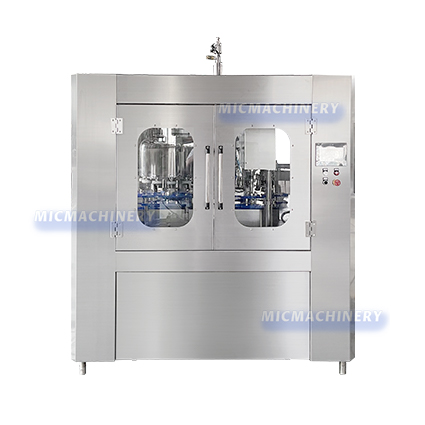
12-1 Juice Can Filling Machine
A 12-1 juice can filling machine is designed with 12 filling heads and 1 sealing head to efficiently fill juice into cans and seal them in a single process. It ensures accurate dosing, hygienic operation, and stable performance, making it suitable for medium to large-scale juice production. |
|
 |
 |
|
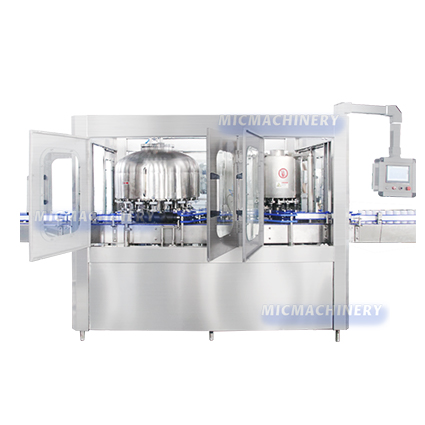
18-6 Juice Can Filling Machine
An 18-6 juice can filling machine is equipped with 18 filling heads and 6 sealing heads to handle juice canning with high speed and precision. It ensures accurate filling, reliable sealing, and hygienic operation, making it ideal for large-scale juice production lines. |
|
|
 |
|
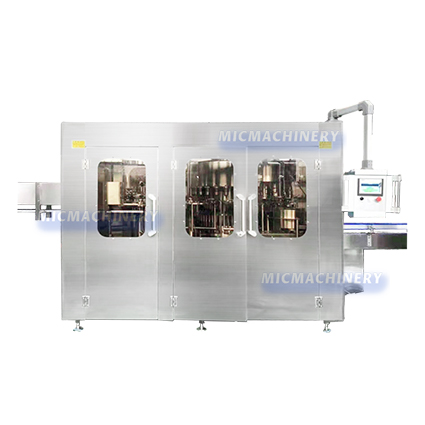
18-18-6 Juice Bottle Filling Machine
An 18-18-6 juice bottle filling machine is designed with 18 rinsing heads, 18 filling heads, and 6 capping heads to complete bottle rinsing, juice filling, and capping in one integrated process. It ensures accurate filling, hygienic operation, and high efficiency, making it ideal for medium to large-scale juice production. |
|
|
 |
|
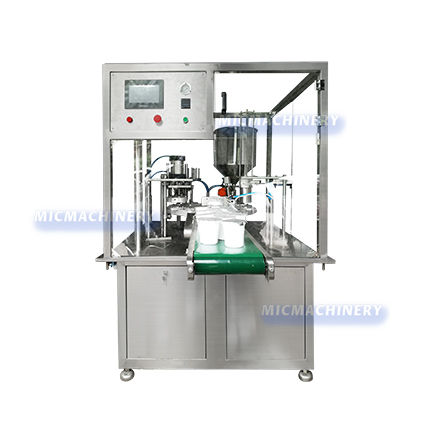
A juice cup filling machine is designed to fill and seal juice into cups quickly and hygienically. It ensures accurate filling, secure sealing, and efficient production, making it ideal for beverage companies producing ready-to-drink juice cups. |
|
|
 |
|
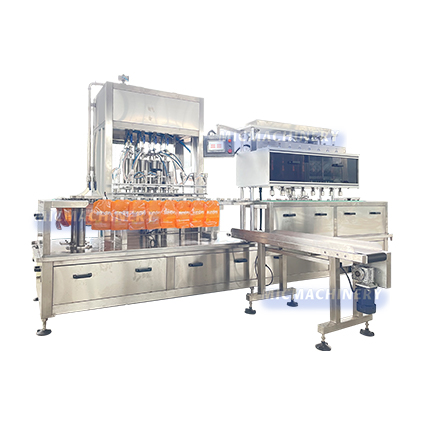
Juice Spout Pouch Filling Machine
A juice spout pouch filling machine is designed to fill juice into spouted pouches with precision and efficiency. It ensures accurate dosing, hygienic operation, and reliable sealing, making it ideal for beverage manufacturers producing convenient, ready-to-drink juice packaging. |
|
|
 |
|
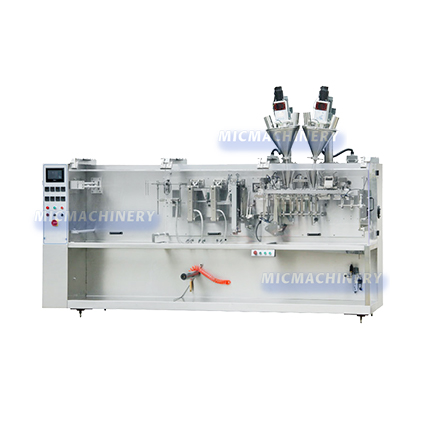
A juice pouch packing machine is used to efficiently fill and seal juice into flexible pouches. It ensures accurate filling, hygienic packaging, and smooth operation, making it ideal for beverage manufacturers producing convenient, ready-to-drink juice pouches. |
|
|
 |
|
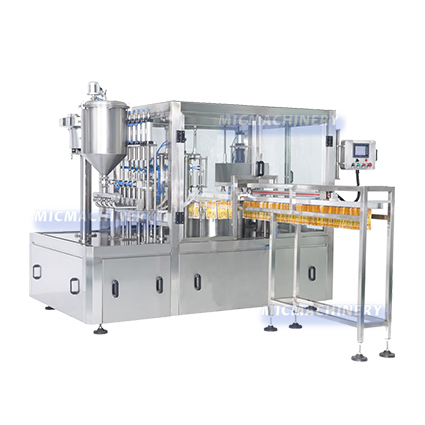
Juice Spout Pouch Packing Machine
A juice spout pouch packing machine is designed to fill and seal juice into spouted pouches in a clean and efficient process. It ensures precise filling, secure sealing, and hygienic packaging, making it ideal for beverage manufacturers focused on convenient juice pouch production. |
|
|
 |
|
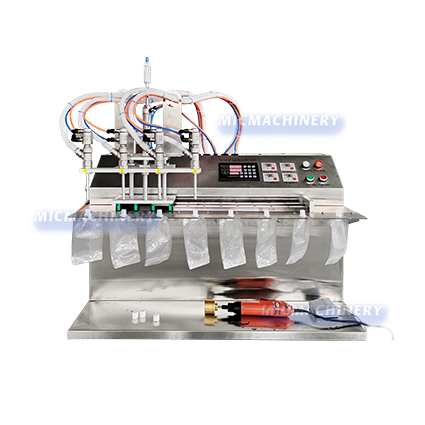
Semi-auto Juice Spout Pouch Filling Machine
A semi-auto juice spout pouch filling machine is used to fill juice into spouted pouches with partial automation. It combines manual handling with automated filling to ensure accurate dosing, hygienic packaging, and cost-effective production, making it suitable for small to medium-scale juice manufacturers. |
|
|