Top 20 Glass Bottle Filling And Capping Machine Companies in 2026
Top 20 Glass Bottle Filling And Capping Machine Companies in 2026
Have you ever admired a beautifully crafted glass bottle of craft beer, premium juice, or artisanal olive oil and wondered how it gets filled without chipping or breaking? What is the glass bottle filling and capping machine, and how does it handle fragile containers with precision? How does a glass bottle filling machine work to preserve product quality while moving at high speeds? How much does a glass bottle filling machine cost for a small startup versus a large distillery? Behind every elegant glass package lies a filling system designed for gentle handling, precise fill levels, and airtight sealing. In this article, we will explore glass bottle filling technologies, troubleshooting tips, and the undeniable benefits of using glass as a packaging material.
What Is the Glass Bottle Filling and Capping Machine?
A glass bottle filling and capping machine is industrial equipment designed to fill glass containers with liquid products—such as beer, wine, spirits, juice, oil, sauce, or premium water—and then seal them with caps, corks, or crown closures. Glass presents unique challenges compared to plastic or aluminum: it is fragile, heavy, and has dimensional variation. These machines must handle glass gently while maintaining speed and accuracy. They typically include rubber bottle grippers, soft-touch starwheels, no-drip filling nozzles, and capping heads with adjustable torque. Leading glass filling machine companies offer systems ranging from semi-automatic tabletop units to fully automatic rotary lines handling 50,000 bottles per hour.
A complete system from glass bottle filling and capping machine companies integrates both filling and capping in a single continuous operation, minimizing transfer points and reducing the risk of breakage or contamination. This integration is especially valuable for glass containers, where every additional handling step increases breakage risk.
How Does a Glass Bottle Filling Machine Work?
A glass bottle filling machine operates through a precise sequence of steps designed to protect the container while delivering accurate fills:
1. Bottle rinsing – Empty glass bottles are inverted and sprayed with sterile water, ionized air, or vacuumed to remove
dust, glass particles, or debris.
2. Bottle indexing – Bottles are transferred via starwheels or conveyor into the filling section. Rubber grippers or neck
holders prevent glass-to-metal contact.
3. Lift and seal – Each bottle is lifted so its mouth presses against a rubber seal on the filling valve, creating an airtight
connection.
4. Filling – The filling valve opens, and liquid flows into the bottle. The method depends on the product: gravity for thin
liquids, pressure for viscous, or counter-pressure for carbonated beverages.
5. Snifting (for carbonated) – For beer or soda, gas pressure is released slowly before the bottle lowers, preventing foam
eruptions.
6. Capping – The bottle moves to the capper, where a cap, cork, or crown is applied. For screw caps, torque is
controlled; for corks, insertion force is regulated.
7. Labeling and packing – Bottles are labeled and packed into cartons or shrink-wrapped trays.
For carbonated products, glass bottle filler companies specialize in counter-pressure filling technology that prevents CO₂ loss and foaming. For still products like wine or juice, gravity or piston fillers are more common.
How Much Does a Glass Bottle Filling Machine Cost?
The cost of a glass bottle filling machine varies significantly based on automation level, speed, container size range, and product type:
• Manual benchtop filler (100–300 bottles/hour): $1,500 – $5,000
• Semi-automatic single-nozzle filler (300–800 bottles/hour): $8,000 – $25,000
• Automatic inline filler (1,000–6,000 bottles/hour): $40,000 – $150,000
• Rotary automatic filler (6,000–60,000 bottles/hour): $100,000 – $800,000+
• Complete glass bottling line (rinser, filler, capper, labeler, packer): $200,000 – $2,500,000+
Many glass bottle filling line companies offer modular systems where you can start with a semi-automatic filler and add components over time. Additional costs include change parts for different bottle shapes (wine vs. beer vs. spirits) and CIP (clean-in-place) systems.
A complete glass bottling line from glass bottling line companies typically includes a bottle rinser, filler, capper, labeler, and case packer, with prices starting around $200,000 for small-scale lines and exceeding $2 million for high-speed rotary systems.
Troubleshooting and Maintenance Considerations
Glass bottle filling machines require special attention due to the fragility of the containers. Common issues include:
• Chipped or broken bottle necks – Worn rubber grippers, misaligned starwheels, or excessive lift cylinder pressure.
Solution: replace grippers monthly, reduce lift pressure to minimum required for seal, and inspect starwheel alignment
weekly.
• Inconsistent fill levels – Worn valve seals, fluctuating product pressure, or dirty level sensors. Replace seals quarterly,
install a pressure regulator, and clean sensors weekly.
• Dripping after fill – Worn valve diaphragms or sticky springs. Rebuild valve assemblies annually.
• Broken bottles in the filler – Incorrect change parts, cracked glass from supplier, or sudden pressure surge. Install a
bottle inspection system before the filler and use soft-start valves.
• Leaking caps or corks – Incorrect torque or worn capper jaws. Calibrate torque weekly and replace capper chucks
every six months.
• Label adhesion problems – Moisture or oil residue on bottle surface. Ensure bottles are dry and clean before labeling.
Maintenance best practices:
• Daily: Inspect all glass-contact surfaces for damage, rinse filling nozzles, check gripper condition.
• Weekly: Check bottle gripper wear, lubricate starwheel bearings, inspect conveyor belts.
• Monthly: Calibrate fill height sensors, inspect lift cylinders for leaks, test capper torque.
• Quarterly: Replace all valve seals and diaphragms, inspect stainless steel for pitting.
• Annually: Send filling valves and capper head for professional rebuild.
Glass packaging machine companies provide comprehensive maintenance support, including spare parts kits, remote diagnostics, and on-site service. Many offer predictive maintenance software that monitors vibration, temperature, and seal wear to alert operators before failures occur.
Glass bottle packaging machine companies focus on downstream solutions such as rinsers, labelers, shrink wrappers, and case packers. Integration with the filler ensures a smooth transition from filling to packaging, minimizing manual handling and breakage risk.
Filling Technology and Mechanisms
Modern glass bottle filling machines incorporate several advanced technologies:
• Gravity filling – Liquid flows by gravity. Simple and low-cost. Suitable for thin, still liquids like water, wine, or juice.
Accuracy: ±1–2%.
• Pressure filling – Product is pumped under pressure. Used for viscous liquids (smoothies, syrups, oils) or hot-fill
applications (coffee, tea).
• Counter-pressure (isobaric) filling – Bottle is pressurized with CO₂ or nitrogen before filling. Essential for beer,
sparkling wine, and soda to prevent foam and retain carbonation.
• Vacuum filling – A vacuum draws liquid into the bottle. Common for high-acid juices and perfumes.
• Piston filling – A cylinder measures exact volume before discharge. Excellent for thick sauces, honey, or salad
dressing. Accuracy: ±0.5%.
• No-drip filling nozzles – Spring-loaded or magnetic nozzles that close instantly after filling, preventing sticky residue on
bottle necks.
• Electronic fill height control – Capacitive or optical sensors detect fill height through clear glass, adjusting fill time in
real time.
• Soft-touch bottle handling – Rubberized starwheels, adjustable neck grippers, and servo-driven lifts prevent glass-to-
metal contact.
• CIP (clean-in-place) systems – Automatically circulate hot water, caustic solution, acid rinse, and sanitizer through the
filler without disassembly.
• Nitrogen purging – For oxygen-sensitive products (wine, juice), a burst of nitrogen displaces air before filling.
Glass bottle filler companies specialize in gentle handling technology, offering features like servo-driven lifts that adjust pressure based on bottle weight, and rubberized starwheels that cradle each bottle individually.
Glass bottle filling line companies integrate fillers with rinsers, cappers, labelers, and packers into a single continuous line. This integration minimizes transfer points, reducing breakage risk and improving overall efficiency.
Advantages and Benefits of Glass Bottle Filling Machines
Why choose glass bottles over plastic or aluminum, and why invest in a dedicated glass filler?
• Premium perception – Glass conveys quality, purity, and tradition. Consumers associate glass with premium beer,
wine, and juices.
• Chemical inertness – Glass does not react with beverages, meaning no plastic taste or aluminum aftertaste.
• Transparency – Customers can see the product's color, clarity, and any sediment (important for unfiltered wines or craft
juices).
• Reusability & recyclability – Glass bottles can be washed and refilled (beer, milk) or endlessly recycled without quality
loss.
• Heat resistance – Glass withstands hot-fill and pasteurization temperatures (up to 195°F / 90°C) without deforming.
• Impermeability – Glass has near-zero oxygen transmission, preserving flavors for years (ideal for whiskey aging or
wine storage).
• Sustainability – Glass is made from abundant raw materials and is 100% recyclable with no loss of quality.
• Brand differentiation – Unique bottle shapes and colors create strong brand identity.
List of 20 Glass Bottle Filling And Capping Machine Companies
 |
Address: Room 1905, Youyi Building, Xincheng Avenue, Cixi, Ningbo, Zhejiang, China |
|
| Mic Machinery is a global supplier of liquid filling and capping automation systems for glass bottle production lines. It is widely recognized among glass filling machine companies, providing complete turnkey solutions for beverage, food, and industrial liquids. The company focuses on hygienic design, precision filling, and stable high-speed operation. Its systems are widely used in modern bottling factories worldwide. |
 |
Address: 152 Longquan Bay, Xueyan Town, Wujin, Changzhou, Jiangsu, China |
|
| BW Filling Machinery delivers reliable filling systems for glass bottle production. It is known for durable engineering and consistent performance in industrial environments. The company serves global beverage manufacturers with automated solutions. Its equipment is widely used in international markets. |
 |
Address: 2224 Wukesong Road, Sanxing town, Zhangjiagang, Jiangsu, China |
|
| Zhangjiagang Mic Machinery specializes in cost-effective glass bottle production systems. It is widely associated with glass bottle filler companies, offering flexible and customizable machine configurations. The company focuses on modular design for different production capacities. Its systems are widely used in emerging manufacturing markets. |
 |
Address: Böhmerwaldstraße 5, 93073 Neutraubling, Bavaria, Germany |
|
| Krones AG is a global leader in beverage filling and packaging automation. It provides high-speed glass bottle filling and capping systems. The company is trusted by major beverage brands worldwide. Its technology is widely used in large-scale industrial production. |
 |
Address: 1535 S State Road 39, La Porte, Indiana, United States of America |
|
| APACKS manufactures compact filling systems for small and medium businesses. It provides flexible solutions for glass bottle packaging applications. The company focuses on simplicity and operational efficiency. Its machines are widely used in startup production environments. |
 |
Address: Avenue de la Patrouille de France, 76930 Octeville-sur-Mer, Normandy, France |
|
| Sidel is a global leader in beverage packaging systems. It is widely associated with glass packaging machine companies and also recognized among glass bottle packaging machine companies for its advanced automated glass bottling solutions. The company focuses on high efficiency, hygiene, and sustainable production design. Its systems are widely used in global beverage factories. |
 |
Address: 50 Schoolhouse Road Somerset, New Jersey, United States of America |
|
| Cozzoli Machine Company specializes in precision filling equipment for glass and liquid products. It is known for accurate filling and reliable performance. The company serves niche beverage and industrial markets. Its machines are widely used in specialty production. |
 |
Address: Stuttgarter Straße 130, Waiblingen, Baden-Württemberg, Germany |
|
| Syntegon Technology GmbH develops advanced packaging and automation systems. It integrates intelligent controls into glass bottle production lines. The company focuses on high-efficiency industrial solutions. Its equipment is widely used globally. |
 |
Address: 4119 Fordleigh Road Baltimore, Maryland, United States of America |
|
| Filamatic provides compact filling systems for small-scale production. It focuses on flexibility and precision engineering. The company serves niche beverage and specialty industries. Its machines are widely used in craft production. |
 |
Address: Juchostrasse 20, 44143 Dortmund, Germany |
|
| KHS GmbH is a major global supplier of beverage production systems. It is recognized among glass bottle filling and capping machine companies, offering high-speed and integrated bottling solutions. The company focuses on industrial automation and efficiency. Its systems are widely used worldwide. |
 |
Address: 2980 Scott St, Vista, CA 92081, United States |
|
| Accutek Packaging Equipment provides scalable filling and capping systems for small businesses. It supports flexible production expansion for glass bottle manufacturers. The company focuses on reliability and modular design. Its equipment is widely used in startup operations. |
 |
Address: Via Italia, 43, Gessate Milano, Lombardy, Italy |
|
| Ronchi Mario S.p.A. specializes in high-precision filling systems for glass bottle applications. It delivers stable and efficient production technology. The company serves global beverage and industrial markets. Its systems are widely used in Europe. |
 |
Address: Via G. Garibaldi, 34N, Bonate Sotto, Lombardy, Italy |
|
| Comac produces compact filling and packaging systems for glass bottles. It is associated with flexible production solutions for small and medium manufacturers. The company focuses on user-friendly machine design. Its equipment is widely used in regional factories. |
 |
Address: Olympus House, Mill Green Road, Haywards Heath, West Sussex, United Kingdom |
|
| Adelphi Packaging Machinery provides customized filling and packaging solutions. It focuses on reliability and ease of maintenance. The company serves beverage and specialty liquid industries. Its machines are widely used in niche production markets. |
 |
Address: N15 W23500 Stone Ridge Drive, Waukesha, Wisconsin, United States of America |
|
| Federal Mfg. manufactures heavy-duty filling systems for industrial applications. It focuses on durability and long-term stability. The company serves beverage and food industries. Its equipment is widely used in factories. |
 |
Address: Hofäckerstraße 9 Crailsheim, Baden-Württemberg, Germany |
|
|
Groninge develops precision filling systems for multiple industries. It is known for hygienic engineering and automation excellence. The company serves beverage and pharmaceutical sectors. Its machines are widely used globally. |
 |
Address: Ko-58 Mameda-Honmachi, Kanazawa, Ishikawa, Japan |
|
| Shibuya Corporation integrates robotics into packaging systems. It provides advanced automation solutions for glass bottle production. The company focuses on innovation and efficiency. Its systems are widely used in Asia. |
 |
Address: 15-39 130th St, College Point, New York, United States of America |
|
| Filling Equipment Company offers flexible filling systems for industrial applications. It supports glass bottle production with customizable solutions. The company focuses on durability and adaptability. Its equipment is widely used in regional markets. |
 |
Barry-Wehmiller Packaging Systems Address: 8020 Forsyth Boulevard, St. Louis, Missouri, United States of America |
|
| Barry-Wehmiller Packaging Systems is a global packaging leader. It provides integrated production systems for glass bottle filling lines. The company is widely associated with glass bottle filling line companies, offering scalable industrial solutions. Its systems are widely used worldwide. |
 |
Address: 1535 South State Road 39, La Porte, IN 46350, United States |
|
| E-PAK Machinery specializes in liquid filling systems for small and medium manufacturers. It is widely recognized among glass bottling line companies, offering cost-effective and flexible production solutions. The company focuses on simple operation and reliable performance. Its machines are widely used in emerging markets. |
Global Distribution of Glass Bottle Filling And Capping Machine Companies by Country

| Country | Number of Companies | Share (%) |
 |
USA | 8 | 40% |
 |
Germany | 4 | 20% |
 |
China | 3 |
15% |
 |
Italy | 2 | 10% |
 |
France | 1 | 5% |
 |
United Kingdom | 1 | 5% |
 |
Japan | 1 | 5% |
List of 9 Glass Bottle Filling And Capping Machine Products
 |
|
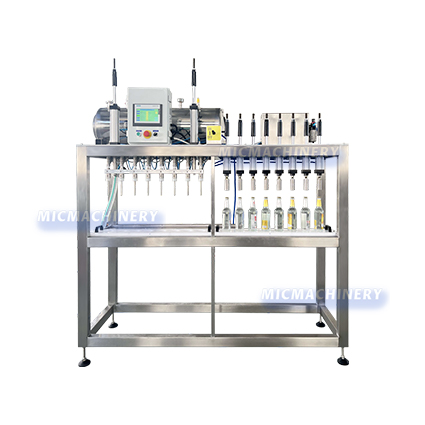
Semi-auto Glass Bottle Filling Machine
A semi-auto glass bottle filling machine combines manual bottle loading with automated filling. It ensures accurate filling, smooth operation, and reliable performance for small to medium-scale glass beverage production. |
|
 |
 |
|
12-12-1 Carbonated Glass Bottle Filling Machine
A 12-12-1 carbonated glass bottle filling machine has 12 rinsing heads, 12 filling heads, and 1 capping head for efficient rinsing, filling, and capping. It ensures accurate filling, hygienic operation, and reliable performance for small to medium-scale production. |
|
|
 |
|
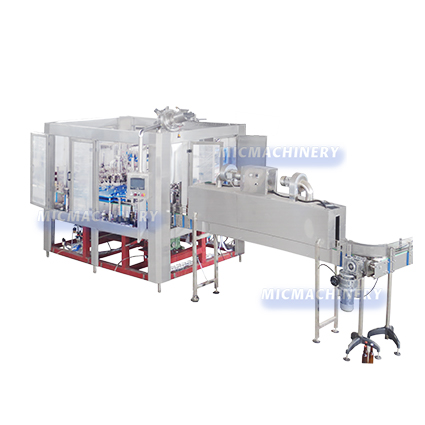
18-18-1 Carbonated Glass Bottle Filling Machine
An 18-18-1 carbonated glass bottle filling machine features 18 rinsing heads, 18 filling heads, and 1 capping head for efficient rinsing, filling, and capping. It ensures precise filling, hygienic operation, and reliable performance for medium-scale production. |
|
|
 |
|
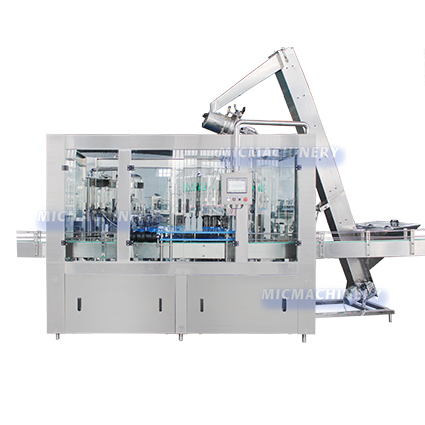
32-32-8 Carbonated Glass Bottle Filling Machine
A 32-32-8 carbonated glass bottle filling machine features 32 rinsing heads, 32 filling heads, and 8 capping heads for high-speed rinsing, filling, and capping. It ensures precise filling, hygienic operation, and reliable performance for large-scale production. |
|
|
 |
|
24-24-6 Carbonated Glass Bottle Filling Machine
A 24-24-6 carbonated glass bottle filling machine features 24 rinsing heads, 24 filling heads, and 6 capping heads for efficient rinsing, filling, and capping. It ensures precise filling, hygienic operation, and reliable performance for large-scale production. |
|
|
 |
|
18-18-6 Glass Bottle Filling Machine
An 18-18-6 glass bottle filling machine features 18 rinsing heads, 18 filling heads, and 6 capping heads for efficient rinsing, filling, and capping. It ensures accurate filling, hygienic operation, and reliable performance for medium to large-scale production. |
|
|
 |
|
24-18-6 Glass Bottle Filling Machine
A 24-18-6 glass bottle filling machine features 24 rinsing heads, 18 filling heads, and 6 capping heads for efficient rinsing, filling, and capping. It ensures precise filling, hygienic operation, and reliable performance for large-scale beverage production. |
|
|
 |
|
12-1 Glass Bottle Filling Machine
A 12-1 glass bottle filling machine features 12 rinsing heads, 12 filling heads, and 1 capping head for efficient rinsing, filling, and capping. It ensures accurate filling, hygienic operation, and reliable performance for small to medium-scale production. |
|
|
 |
|
Linear Glass Bottle Filling Machine
A linear glass bottle filling machine features bottles moving in a straight line through rinsing, filling, and capping stations. It ensures accurate filling, smooth operation, and efficient production for medium to large-scale beverage bottling. |
|
|